

A blustery, wet day buffeted walkers setting out on the Eco-Museum of Scottish Mining Landscapes’ Route 50 on 29 March – an event offered by the charity as part of East Dunbartonshire’s Local History Month.
Led by local historian and photographer Edward Z Smith, the group started from the now derelict miners’ club, whose single-storey ‘stute hall was built in the late 1920s with money deducted weekly from the miners’ wages. Here’s where Waterside Community Hub will be built.
The miners who trudged these paths with piece, helmet and heavy boots to toil away in dark, danger and dirt were in our minds as we followed the Luggie upstream. Without their labours our project would not exist.
Along the route Edward told of the mills and the weavers’ cottages; pointed out the subscription school – once Waterside’s only school; recounted the extraordinary tale of the stone sleepers from the Glasgow-Edinburgh railway (some of which were repurposed by miners as stepping stones); indicated the WW2 anti-tank obstacle designed to slow down invading troops; stopped at the site of the much-missed Wester Gartshore bridge; before guiding us along the former wagonway and past the coke kilns and settling pools.
There was a fascinating stop at what were once the pit management houses: the father of one of our walkers had been pit manager, so they’d lived there. And then it was on to the industrial park, where the buildings that originally housed the former pithead canteen and baths can still be seen.
At the end of the walk, Edward distributed copies of the anthology of verses by former Waterside miner and poet William Surgeon, who in a few lines paints atmospheric pictures of the pit, the canteen, and life in the first half of the twentieth century.
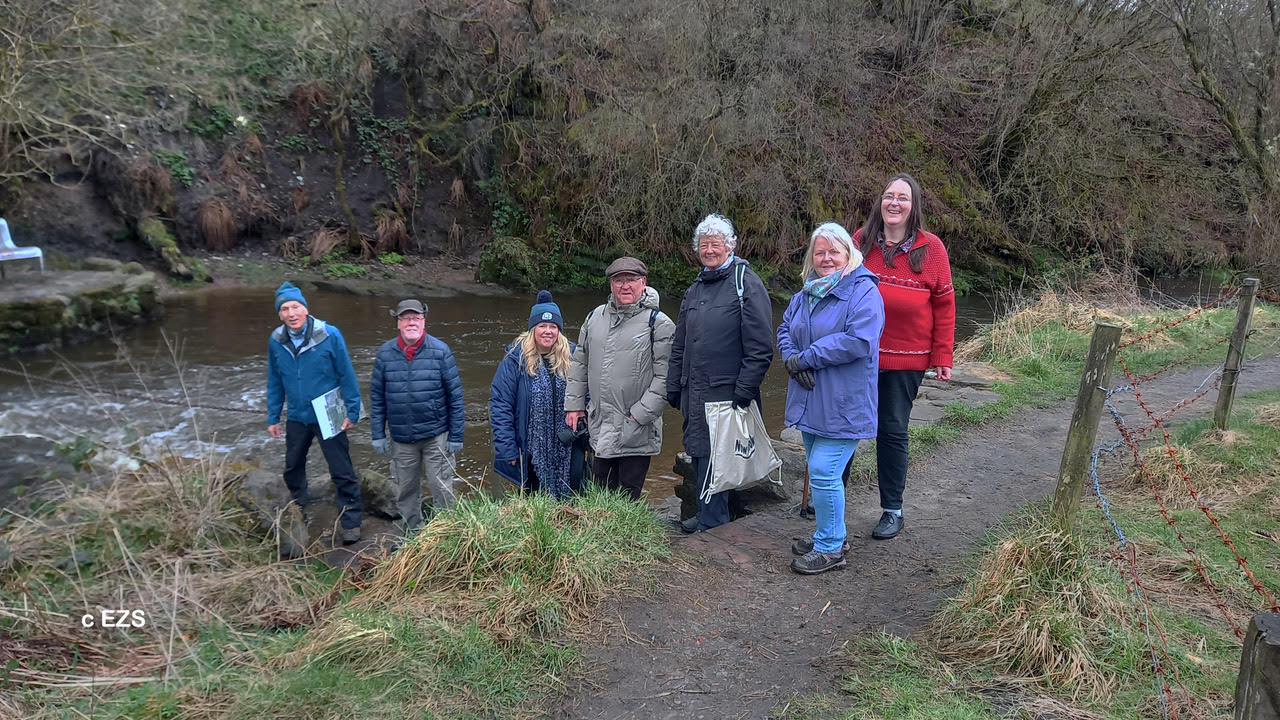
The Luggie flowing fast over the sleeper stepping stones

The one-time pit manager’s and undermanager’s houses, with a former occupant in the middle